
This is a free 21 page printable pdf packet for planning your homeschool. It is useful for new homeschoolers and as a once a year recentering exercise for experienced homeschoolers as well.
Why It Matters
Homeschooling is a big deal. Your kids get one shot at growing up and the family children are raised in has a profound affect on their future employment, future relationships, and future happiness.
But you are their parent for a reason. As long as you take a thoughtful approach and do your best, you’ll be the best possible for your kids.
Homeschooling is a big part of family life, in fact it colors everything else about your family and children. Homeschooling will become part of your identity. So its important to think about your goals and the approach you need to take.
Homeschool Planning Packet
We have created the Homeschool Planning Packet to help you think through your homeschool, an exercise you will need to repeat once a year at least.
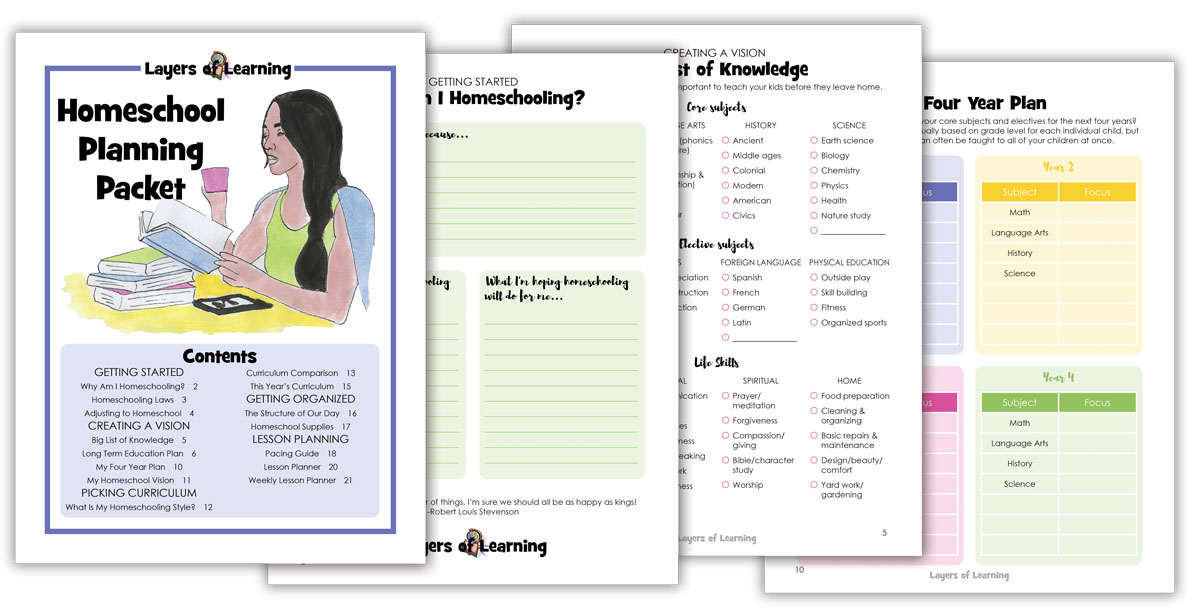
The Homeschool Planning Packet is free, so grab one now.
Put the packet in a binder that you can look at and refer to often. In my homeschool binder I also keep wishlists of books and homeschooling resources, ideas for things I want to do with my kids, websites we like (along with log-in/password info.), goals, and more. Between this free printable packet and the Mentor Planner, you’ll find all the pages I keep in my Homeschool Binder.
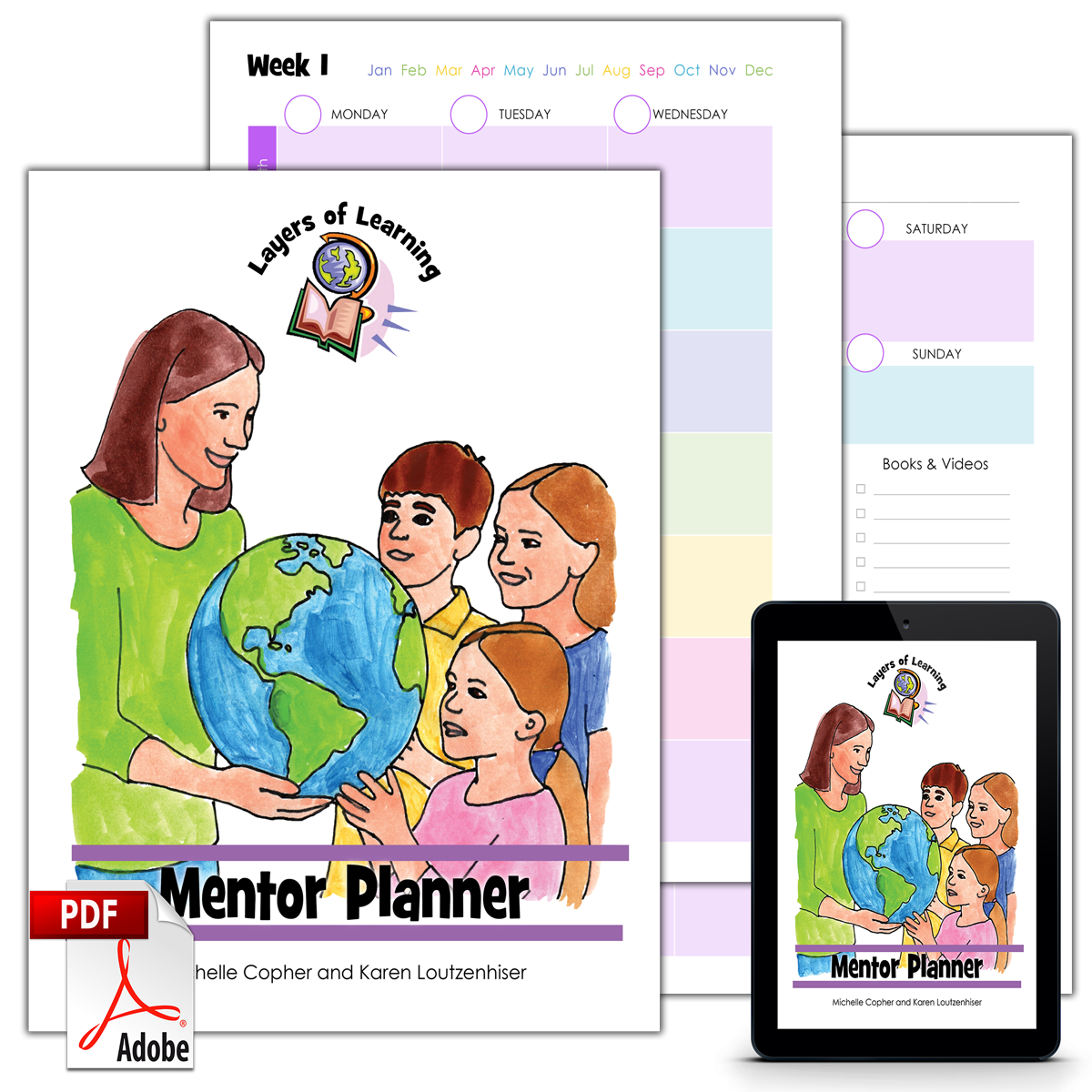
Layers of Learning Mentor Planner – PDF 2026
A simple weekly planner for your Layers of Learning homeschool. This PDF printable planner is for the adult mentor.
Getting Started
This section of the packet helps you think through the nitty gritty of homeschooling including why you’re doing it, how you can do it legally, and how you can calm your mind and spirit after leaving government schools so you can start your homeschool journey fresh and rested.
Defining Your Why
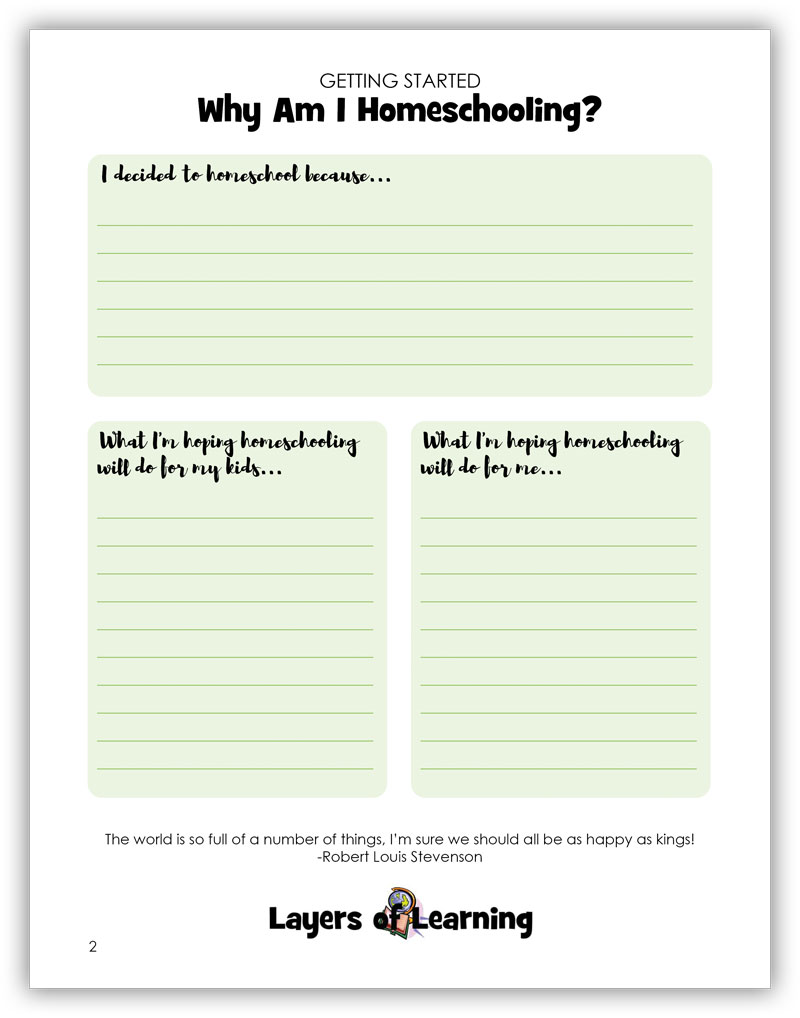
The packet starts off helping you define your why. Why are you homeschooling? Once you understand your reasons fully, you will do a better job planning and a better job staying on task and staying motivated.
Homeschool Laws
Next is a page where you can make notes about the homeschool laws where you live. It’s extremely important to follow the law. Not to freak you out or anything, but kids can be taken from a parent if the state suspects the children are not being educated.
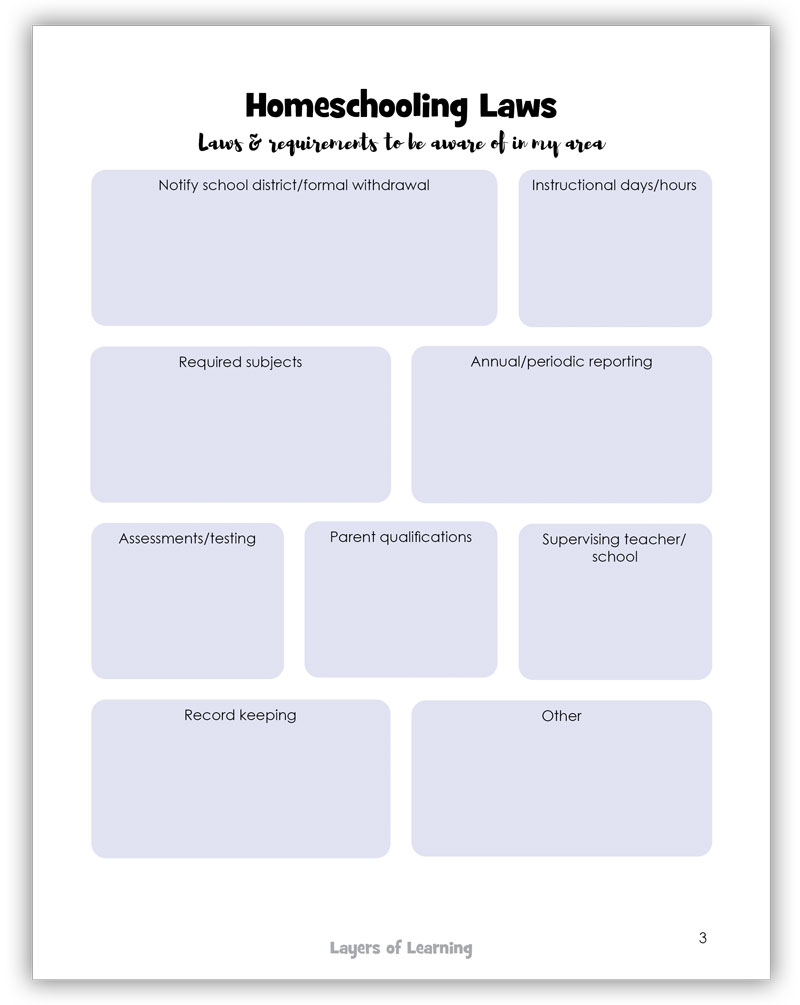
Every state and every country is different so you will need to search online for the legal requirements in your state.
Adjusting to Homeschool
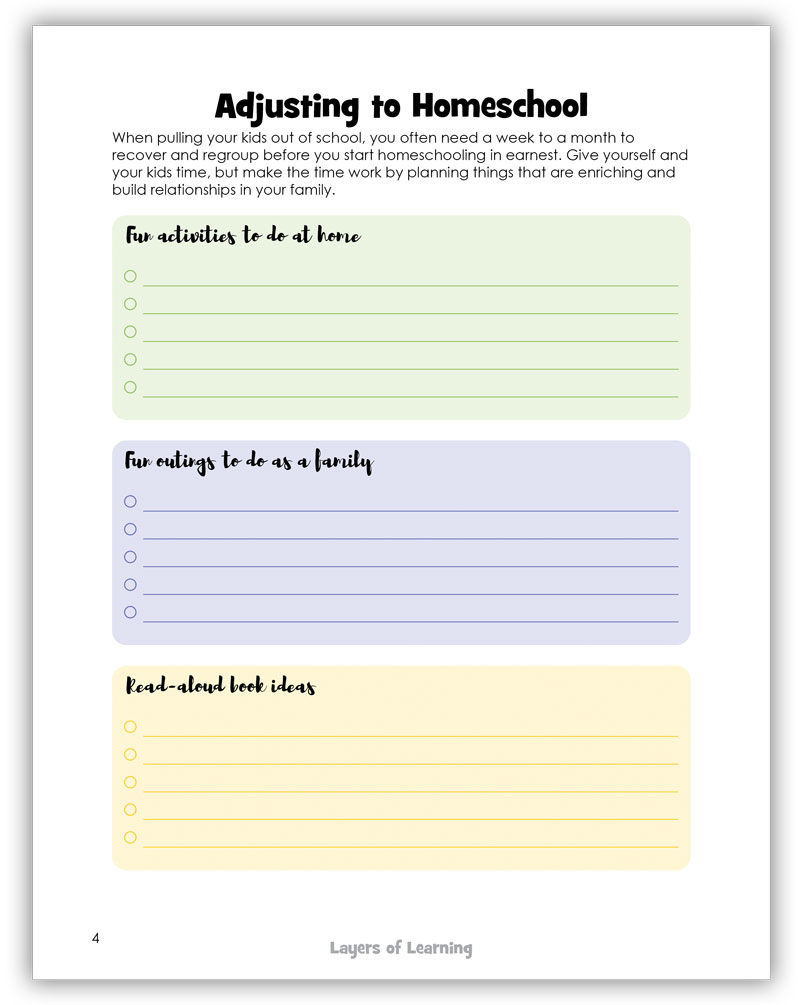
If your kids are being taken out of public school, everyone in your family needs a few weeks to decompress, to have a brain break, and to reset their emotional and mental state. You need rest and a clean break. So take the time you need. There is a page in the planner that helps you list some fun activities and read-aloud books that can help in the reset and reconnect your family.
Creating a Vision
You gotta have a goal if you want to achieve. This section of the packet helps you define where you hope this journey will take you by the time your child is 18 and ready to leave your home.
Educational Plan
Now we get to the meat of the packet. In this next section you will be ticking off the school subjects you want your kids to know and the other life skills you want them to know.
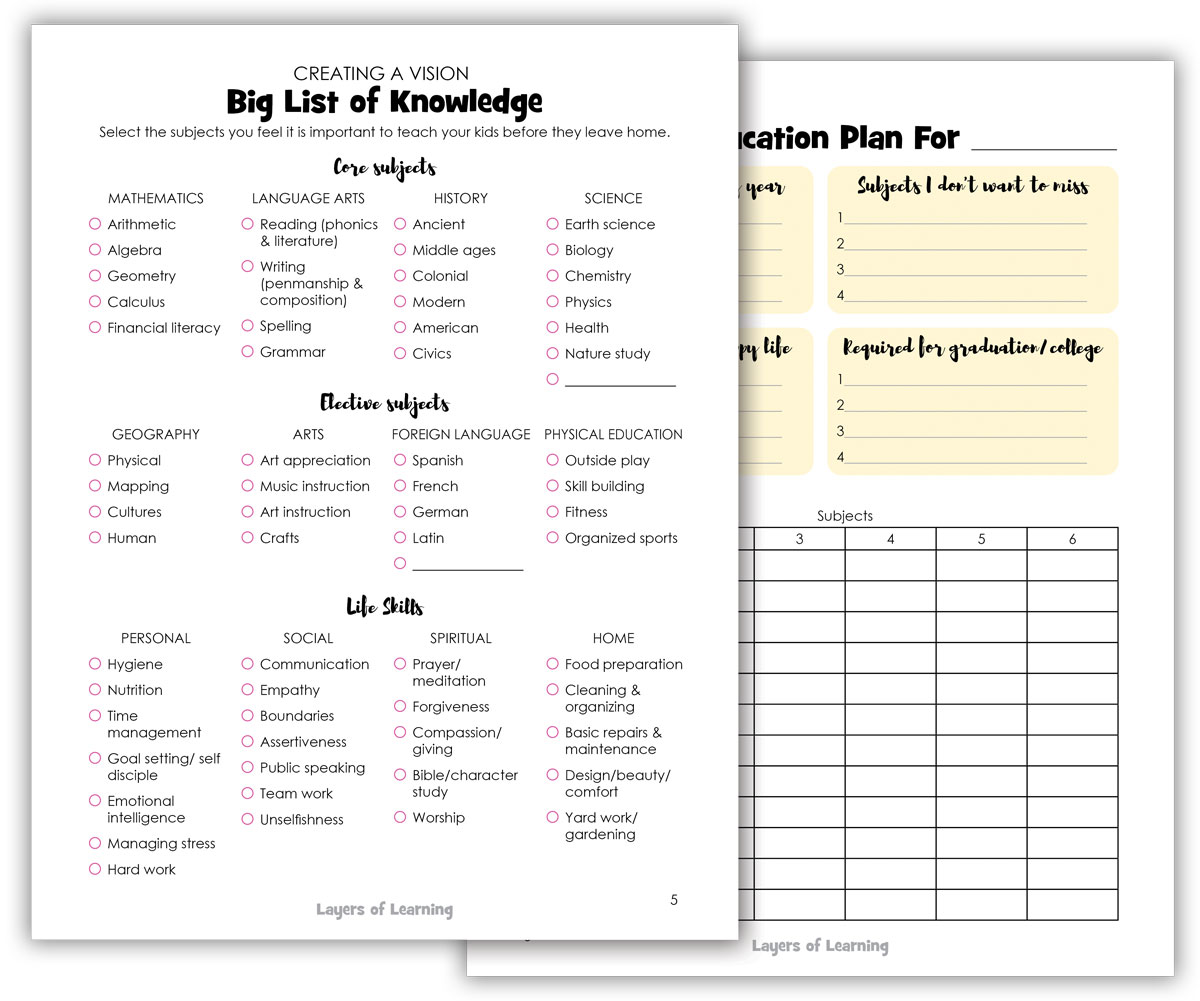
This is immediately followed by a Long Term Education Plan. You will use one of these sheets per child. It helps you schedule in the classes and subjects your child will complete clear through graduation. It will give you peace of mind to be able to see how everything will fit together and it also will help you to avoid overscheduling. There are only six subjects per year, which is plenty. Though you can have a single semester class, such as health or an elective.
Layers of Learning’s Four Year Cycle
Next you will plan the next four years. Layers of Learning works around a four year cycle. It takes four years to get through all of history, geography, science, and art. Even if you don’t use Layers of Learning, it is helpful to break down the 12 years of your child’s schooling into three manageable chunks to include the early years, the middle grades, and then high school.
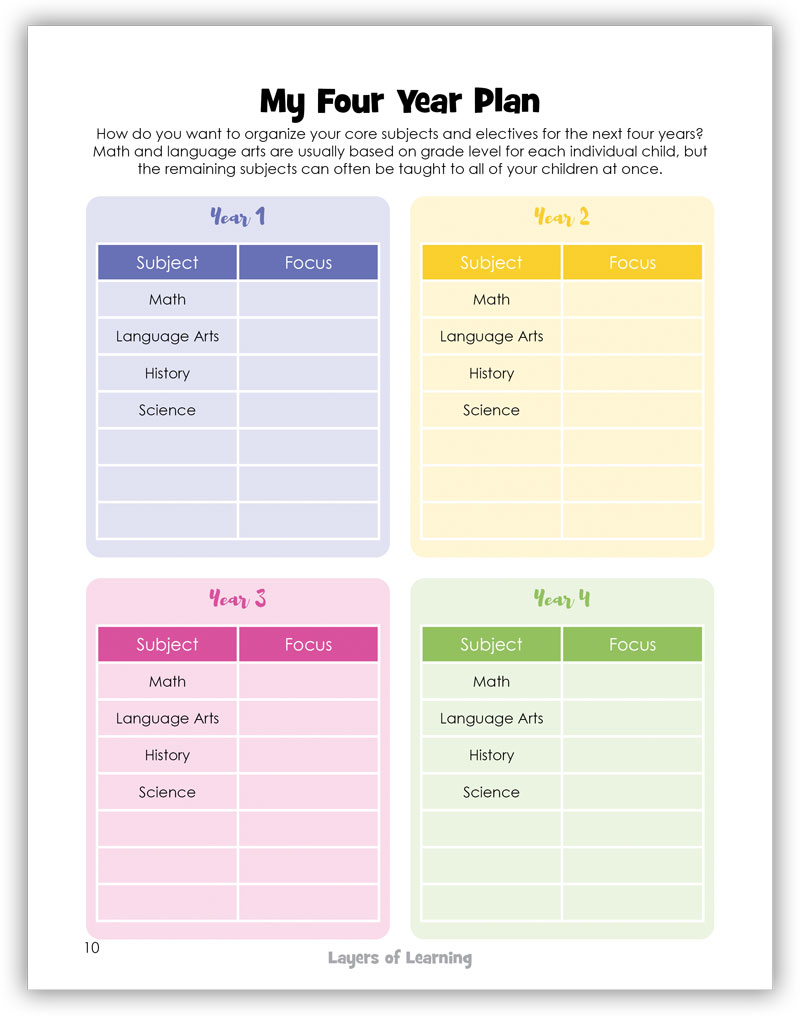
Planning your next four years will help you to see when you will be studying biology and modern history and ancient art, and so on.
Your Homeschool Vision
Whether we realize it or not we all have an image in our minds of what our perfect homeschool day will look like. Some parents might envision their children sprawled across the living room, each working independently. Others might see the whole family gathered around the kitchen table and working together on projects. Whatever you homeschool vision, you should be aware of your expectations.
Whatever your expectations they won’t be met. Not entirely at least, because you have children. Still, knowing your expectations can help you set the stage and prevent a whole lot of frustration on your side.
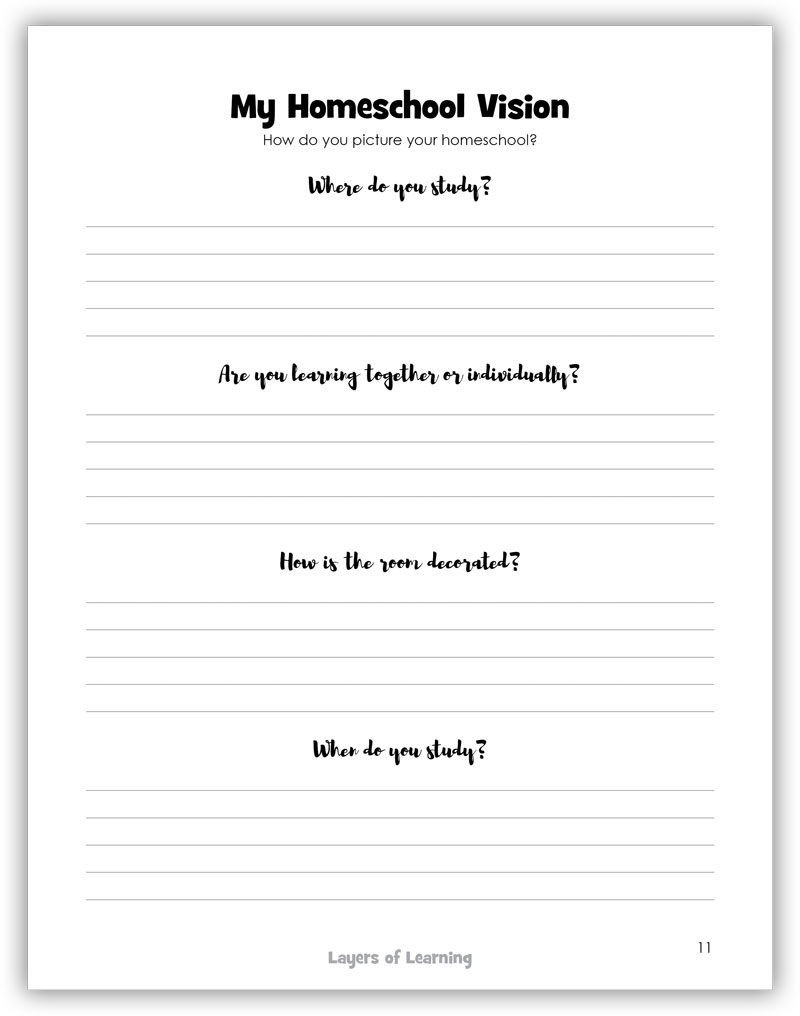
Write down where you study, if you envision a family-style school or individual scholars, what your homeschool space looks like, and when you do your studying. Is it a block of time set aside in the morning or do you learn in snippets spread across the day, or perhaps a couple of hours in the evening?
Picking Curriculum
Choosing curriculum is usually the first place a new homeschooler’s mind goes and is also one of the most intimidating parts of starting your homeschooling journey. The curriculum you choose will help to mold your child’s mind and it will either make your life easier or harder. The tricky thing is that there are dozens and dozens of options and the best one depends on you and your children’s needs.
Your Homeschool Style
The first step in picking curriculum is defining what is important to you and figuring out how your personality meshes with some of the major homeschooling styles. So we created a simple a checkbox questionnaire that helps you define what is important to you in education and these checkboxes will help you to see what your homeschool style is.
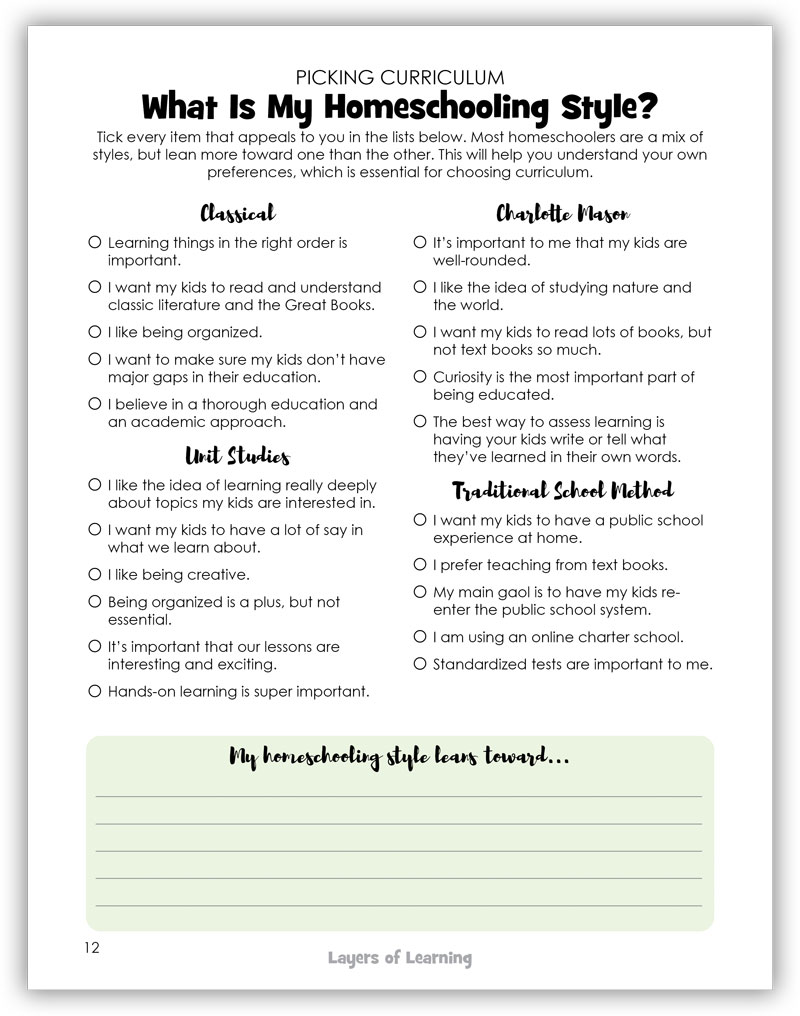
There are four major homeschool styles (and dozens of minor ones) including Classical, Charlotte Mason, Unit Studies, and Traditional School. Understanding your style will help you to find the resources that will fit best with your vision.
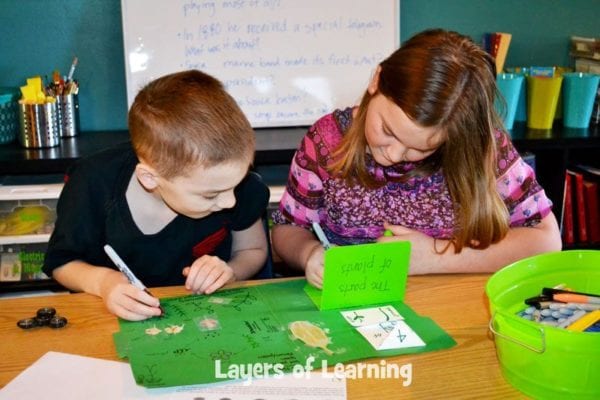
Homeschool curriculum tends to be built around one of the four major styles of homeschooling, so if you can define what type of learning appeals to you, then you can zero in on the resources that fit and get rid of lots of noise. However, there is no need to be a purist. You can mix traditional style workbooks with unit studies or classical and Charlotte Mason to your heart’s content.
Layers of Learning combines Classical, Charlotte Mason, and Unit Studies styles. That means order, lots of living books, a four year cycle, hands-on projects, a great deal of flexibility, and curiosity based learning.
Curriculum Comparison
The next sheet is a chart that helps you compare various curriculum options after you have searched online for “Charlotte Mason history curriculum” or whatever your style is. This part of picking curriculum takes time. You’ll probably spend, at least, several hours on each subject. Then you’ll do it again next year, and the year after that . . .
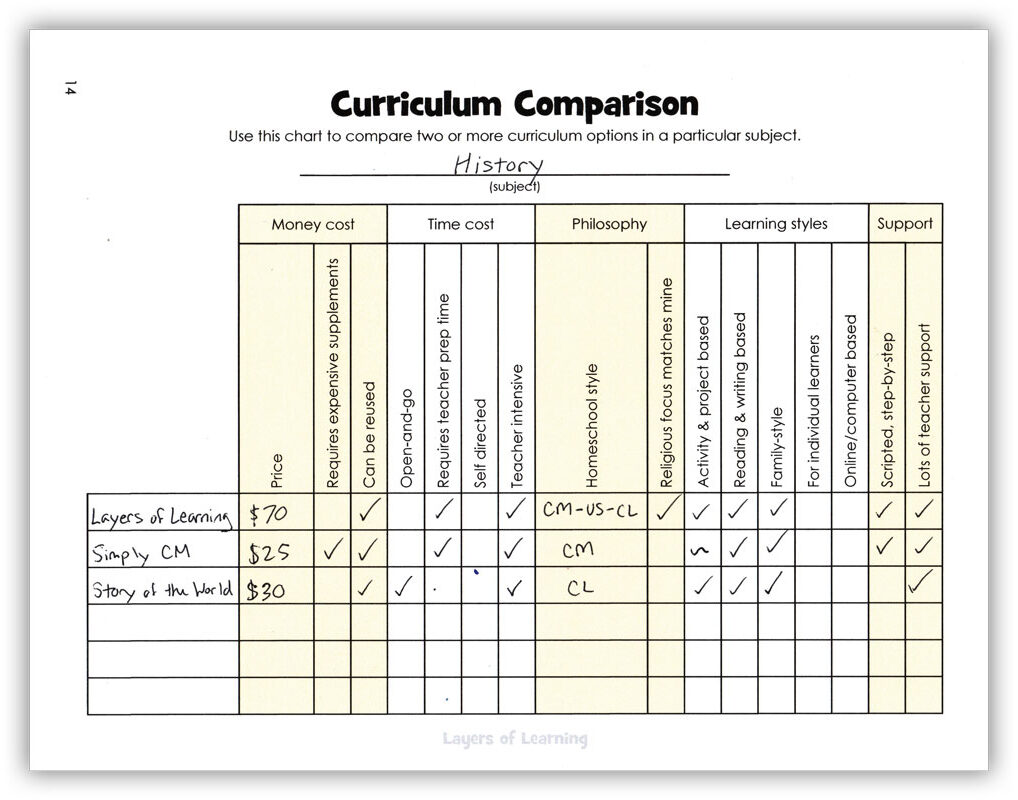
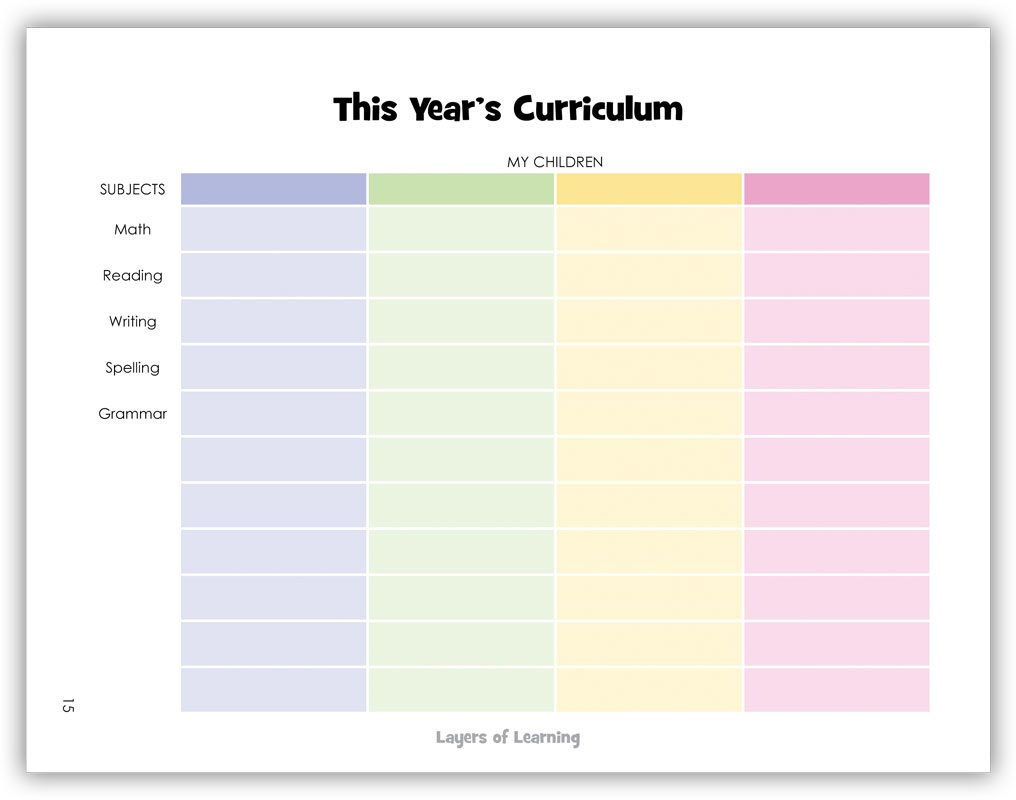
Next, you’ll write down which curriculum options you have chosen for each of your children.
Getting Organized
Now that you know what your homeschool will look like and you’ve chosen curriculum, it’s time to figure out how to put it all together.
Daily Structure
It’s important to think through how you are going to organize your time. Begin by blocking out hours of your day for chores, meals, school, play time, work, and so on.
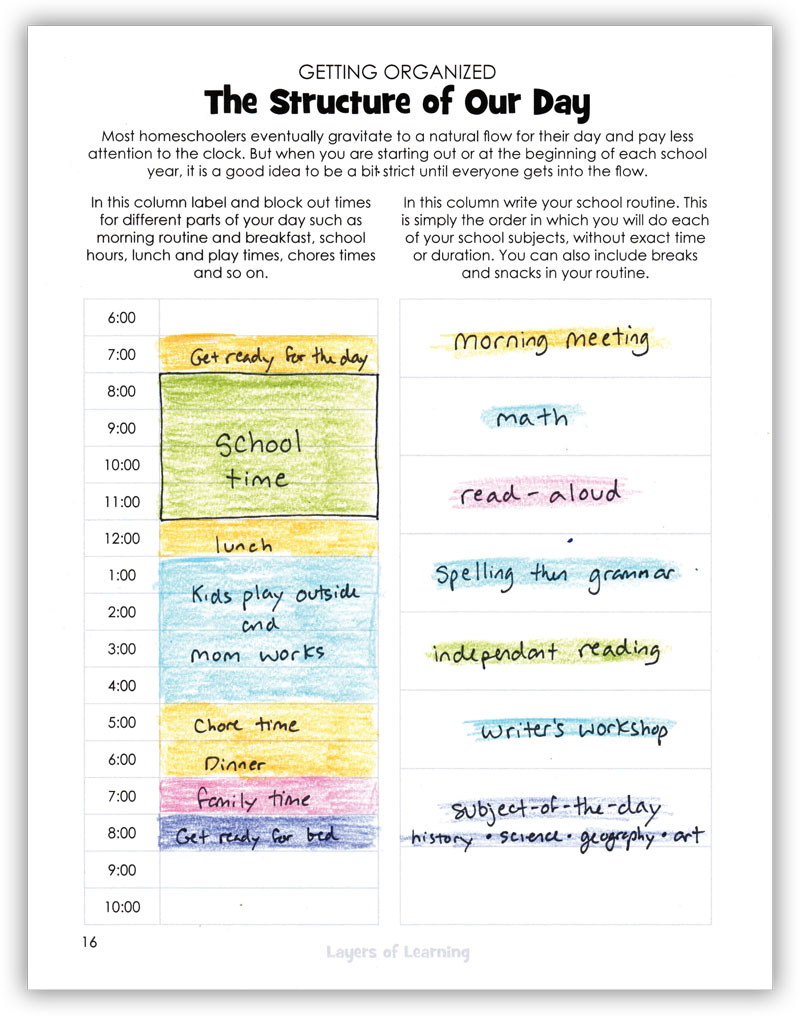
Then come up with a rhythm to your school hours. This is just the order of the subjects you plan to do. We recommend you do not plan an exact timetable for your school subjects. This leads to unnecessary stress when your day doesn’t go as planned, which will be most days.
Both the schedule and the rhythm are a starting point to give you structure and a vision. They keep things orderly and prevent school from taking over your day or getting shoved out of it. But the schedule shouldn’t become a prison. Let it adjust and flow as you deal with real life.
Homeschooling Supplies
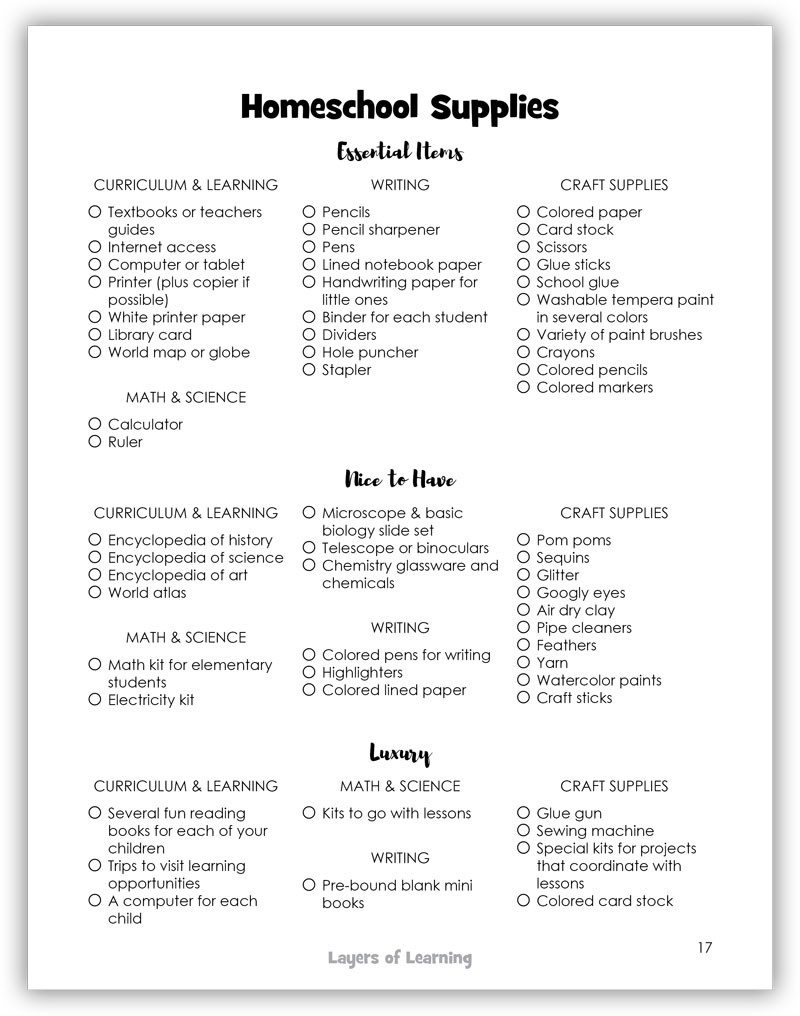
Next we provide you with a big list of basic supplies that nearly every homeschooler has or wants. It is divided into three sections: essential, nice to have, and luxury. Just stock up on what you can. Don’t worry, before you know it your major problem will be finding space to store all this stuff.
Lesson Planning
This is the final section of the packet. A lesson is a single day’s lesson on a single subject. For at least half of your subjects you won’t need to do any lesson planning. Math is usually just moving to the next chapter, tutoring the concept, and having your child work problems. Same with spelling and grammar. There’s no prep, just the next page in the workbook. But other subjects, like history or science, usually require more thought and time.
Pacing Guide
A pacing guide helps you to figure out how to space out the topics or lessons to exactly fill your school year. A typical school year is 36 weeks. The weeks are easily divided into nine months of four weeks each.
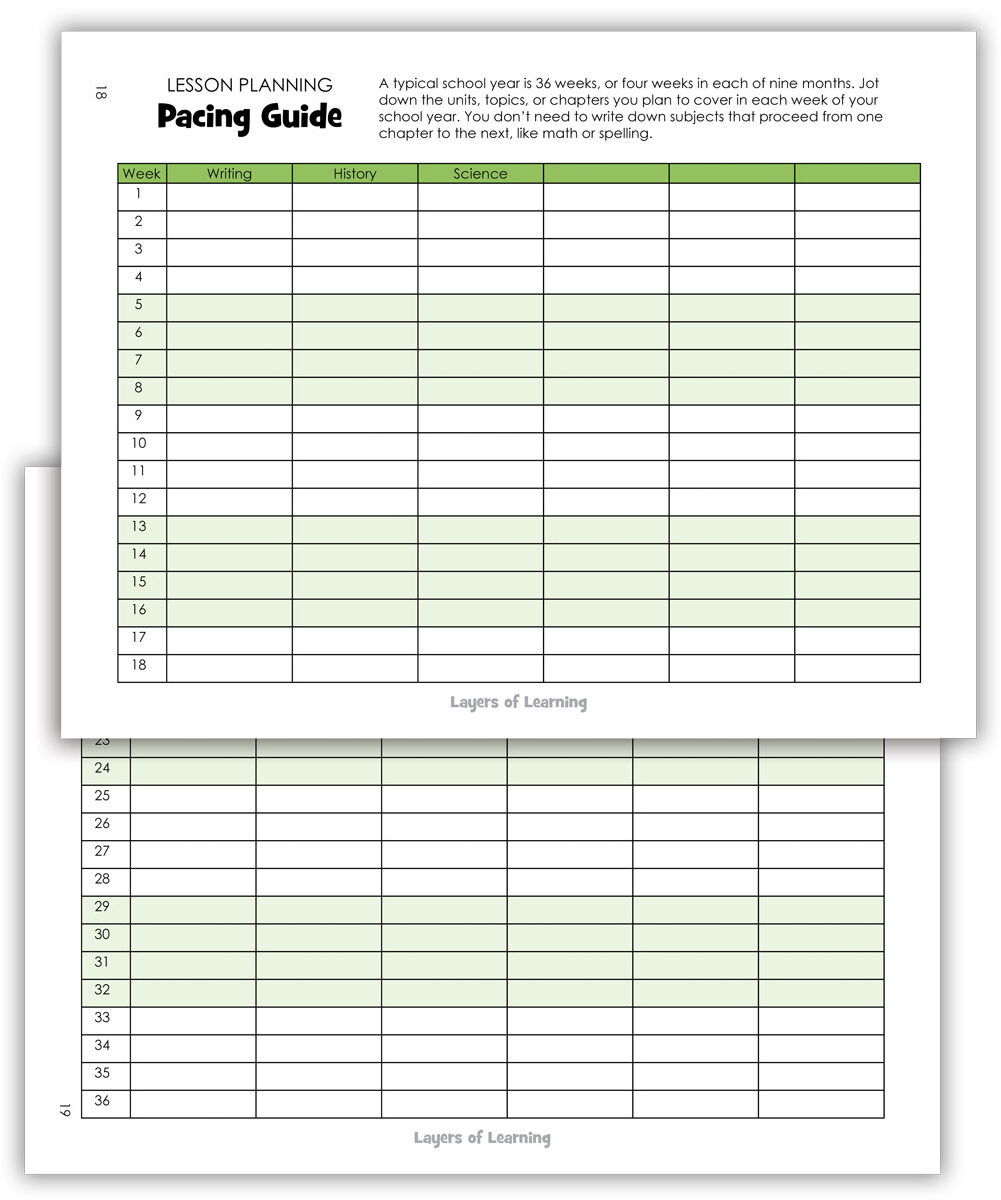
You will just write down “Reports & Essays” under the “Writing” column across the weeks you plan to teach that writing unit, and so on. You don’t need to get more detailed than the unit titles on a pacing guide. Math and other subjects that move in order from chapter to chapter don’t really need to be paced out. Instead you go at your child’s pace. Some math lessons will be a single day and others might take a week. It’s better to not strictly schedule skills based subjects.
Lesson Planner
This page is for planning a single lesson for a single day. You will not write out a plan like this very often once you are through the first few months of homeschooling. But when you’re starting it’s helpful to understand the parts of an effective lesson so it becomes second nature.
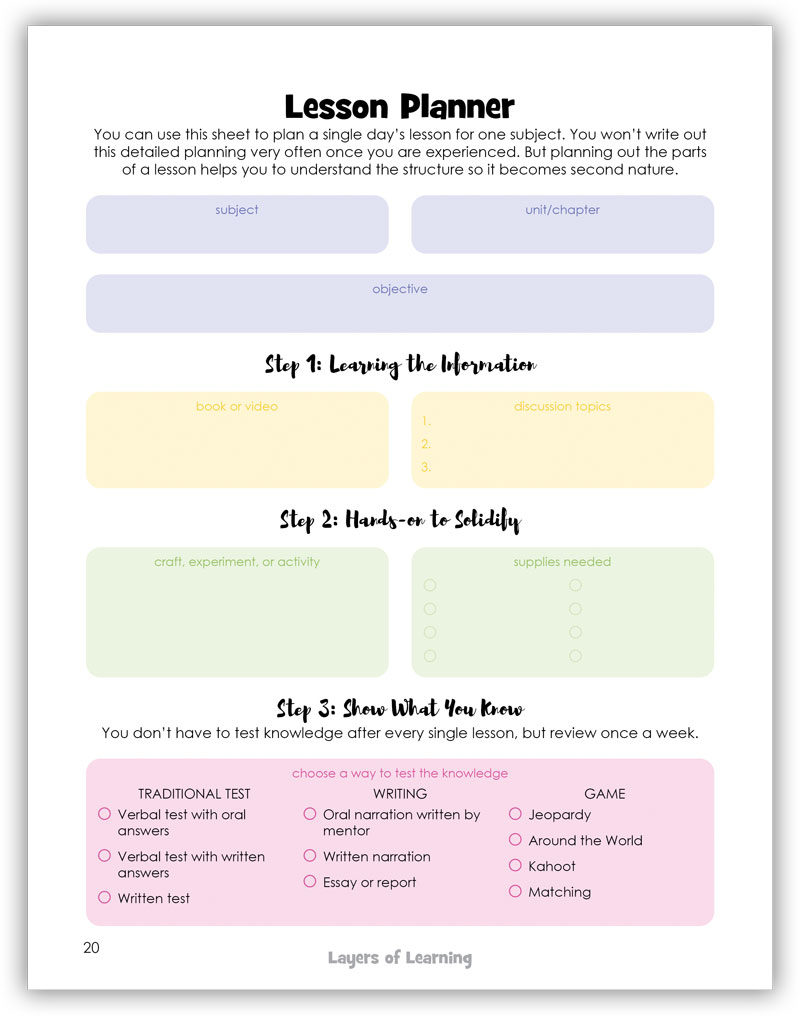
First, always know what it is you are hoping your children learn from the lesson. It could be facts, concepts, or it could be moral or philosophical or all of the above.
Then plan how you will present your information. This is the lecture portion and in homeschool it is usually presented as a book or encyclopedia page you read together or a video you watch together. Your discussion of what you learned will shape the things your children take away from the lesson, so refer back to your purpose when planning topics to discuss.
Next, plan a hands-on activity. This could be anything from making a salt dough map to filling out a worksheet or adding dates to a timeline. Doing something solidifies the information as the child uses what was learned during the lecture.
Finally, show what you know though testing of some sort. This can take the form of a traditional test, a writing assignment, or a quiz game.
Weekly Lesson Planner
Now that you’ve got what a lesson looks like under your belt, you can plan each week of your homeschool in more detail. Basically you are putting it all on a calendar.
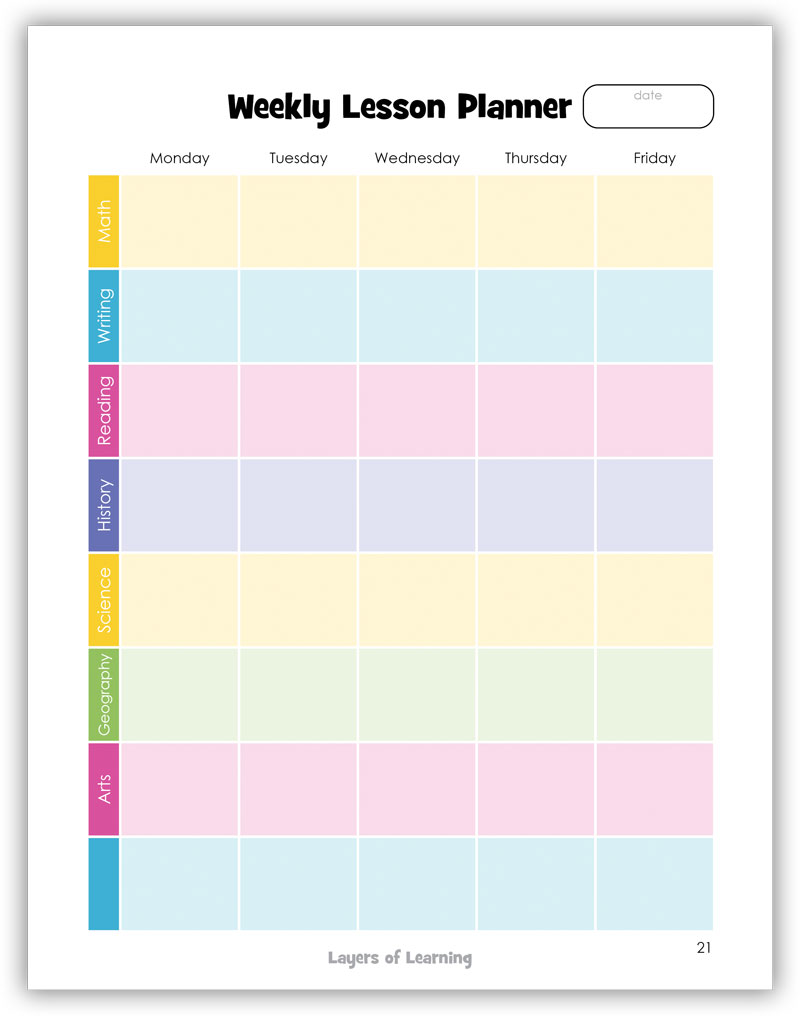
This is a very simple, one page weekly planner. You will write down the unit, book or video, and project idea in each square.
The Layers of Learning Mentor Planner has roomier weekly planning pages with more detail and space for supply lists. You can get it in PDF or Paperback versions.
Layers of Learning Mentor Planner – PDF 2026
A simple weekly planner for your Layers of Learning homeschool. This PDF printable planner is for the adult mentor.
Layers of Learning Mentor Planner – Paperback 2026
This is a simple weekly planner for your Layers of Learning homeschool. It includes a monthly calendar, weekly planner, attendance and grading sheets, a space for notes, and a section of information references. This spiral-bound planner is for the adult mentor.
A Guide and a Comfort
The Homeschool Planning Packet is meant to be a guide and a comfort. It should give you peace of mind that you’re heading in the right direction with deliberation. I fill out a new one nearly every year as I think through my children and their needs. For us, homeschooling has been a massive blessing that I wouldn’t trade for anything.